


Young People Living with Epilepsy are Building Independence and Brighter Futures
September 4, 2026
A Safer Kitchen, A Stronger School: Majoreni’s Journey Towards Better Learning
September 14, 2026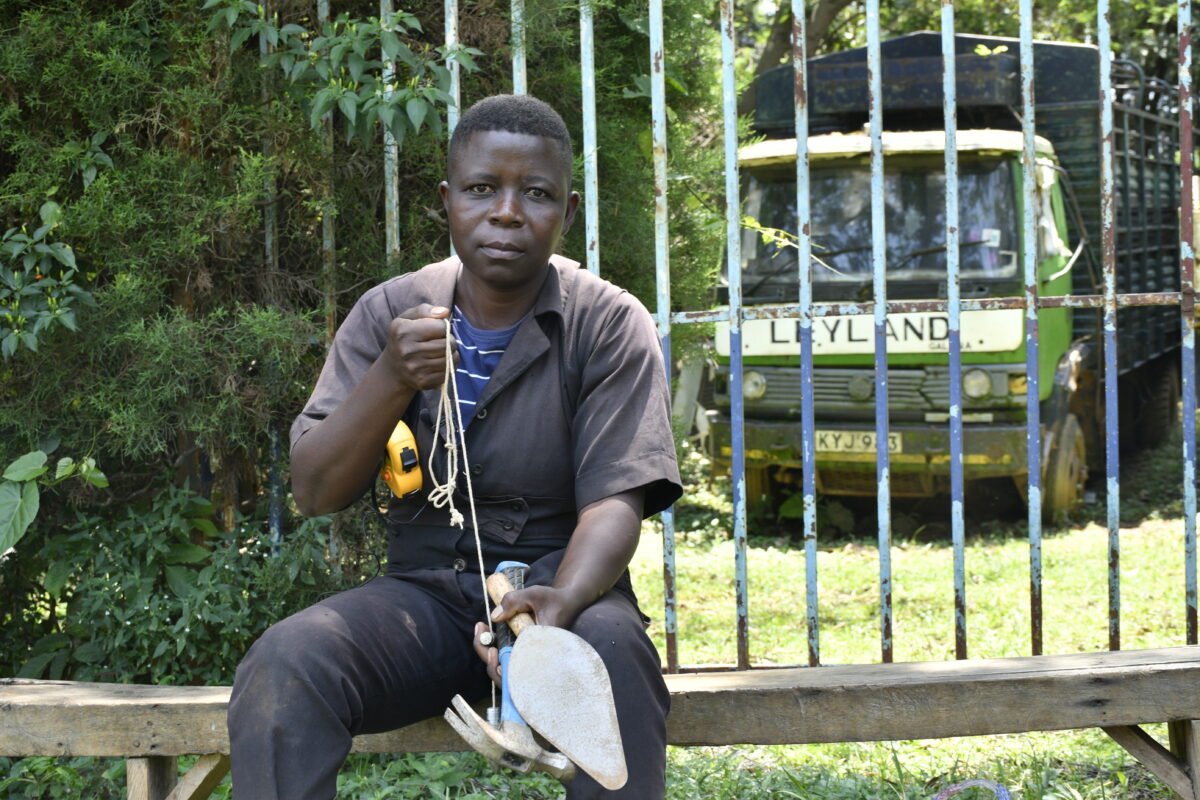
Sheryl Atieno was born and raised in Sagam, a small village in Gem Sub-County, Siaya County. She attended primary school in the area but was unable to complete her secondary education due to financial challenges. Today, Sheryl has attained masonry skills that have changed her life for the better, enabling her to support her son, mother and siblings.
From a young age, Sheryl was passionate about construction. Inspired by women working as masons, she believed she, too, could build a career in construction and dreamed of becoming an engineer or working on construction sites.
In 2025, Sheryl completed her masonry training at Mindhine Vocational Training Centre in Siaya County. However, completing her training did not immediately translate into employment. She often missed out on construction opportunities because she lacked the basic tools needed to practise her trade.
Her circumstances began to change when she joined Rawa Young Ladies, a community savings group supported through the Mwanamke Bora project, implemented by SCORE-Kenya, KCDF’s community partner in Siaya County.
Mwanamke Bora Project is a KCDF initiative funded by Sisters of Incarnate and implemented in partnership with SCORE in Siaya County and the Amboseli Ecosystem Trust in Kajiado County. The project seeks to economically empower vulnerable women, particularly young mothers and women-led households, by improving access to healthcare, food, housing and education, strengthening agricultural productivity and livelihoods, supporting micro, small and medium enterprises (MSMEs) to become sustainable beyond project support, and reducing the time women spend on unpaid care and domestic work while enhancing their economic participation and overall wellbeing.
Before joining the project, Sheryl struggled to meet the needs of her household. She had difficulty paying her son’s school levies, providing food, covering medical expenses and supporting her elderly mother. Without an income or the equipment needed to practise masonry, building a sustainable livelihood remained a challenge. By joining the group, this move opened new opportunities for her skills development, savings and access to capital.
Through the Mwanamke Bora project, Sheryl received business development training, training on savings, and a masonry start-up kit comprising a hammer, masonry trowel, plumb bob, measuring tape and wooden float. The project also provided a loan kitty boost to her group, increasing members’ borrowing capacity and giving Sheryl greater access to capital to invest in her business.
The support has transformed her ability to earn a living. Before receiving the support, Sheryl saved KES 250 per week through her Savings and Internal Lending Community (SILC) group. With the masonry tools and training, she became more confident in seeking construction opportunities and began earning between KES 1,000 and KES 1,500 on days when she got masonry work. Her increased income has enabled her to save up to KES 5,000 a month, while her shares in the SILC group give her a borrowing capacity of up to KES 20,000.
The increased access to credit has also allowed her to borrow more money, invest it in her business and repay her loans with greater confidence.
“Before the Mwanamke Bora project, I used to be broke because I had no income or the motivation to create a life of my own, earn an income and build a life that I love. Today, I am a better woman, looked up to in society as a Mwanamke Bora. I would like to tell other women that they can succeed in life by working hard and being willing to learn new skills that will improve their livelihoods. A big thank you to KCDF, SCORE, and all the funders of the project for taking the time to train me, sparing resources to invest in community members like me and holding my hand to rise and make my own income.” Shares Sheryl Atieno.
One year after receiving support from the project, Atieno is better able to provide for her dependents. She can now pay her son’s school levies and fees, support her elderly mother, and pay for her medical cover, which also covers her son.
Beyond the financial gains, the project has helped Ms Atieno develop a stronger sense of confidence and independence. Interacting with women engaged in different businesses has motivated her to work harder, save part of her income and continue growing her masonry business. She has also learned to be proactive in seeking construction opportunities rather than waiting for work to come to her.
Ms Atieno’s journey demonstrates how access to practical skills, appropriate equipment, savings mechanisms and affordable credit can help women turn their skills into sustainable livelihoods. From struggling to find work because she lacked basic masonry tools, she is now earning an income from her trade and contributing to the well-being of her household. For younger women in her community, her story is a reminder that with the right skills, opportunities and support, it is possible to build a livelihood, support a family and create a more secure future.